Amid devastating funding cuts, Roger Lehecka Double Discovery Center hosts 60th Anniversary Gala
The gala comes after the center, which supports low-income high school students, lost 95percent of its funding in March after the federal government cut grants to Columbia.
By
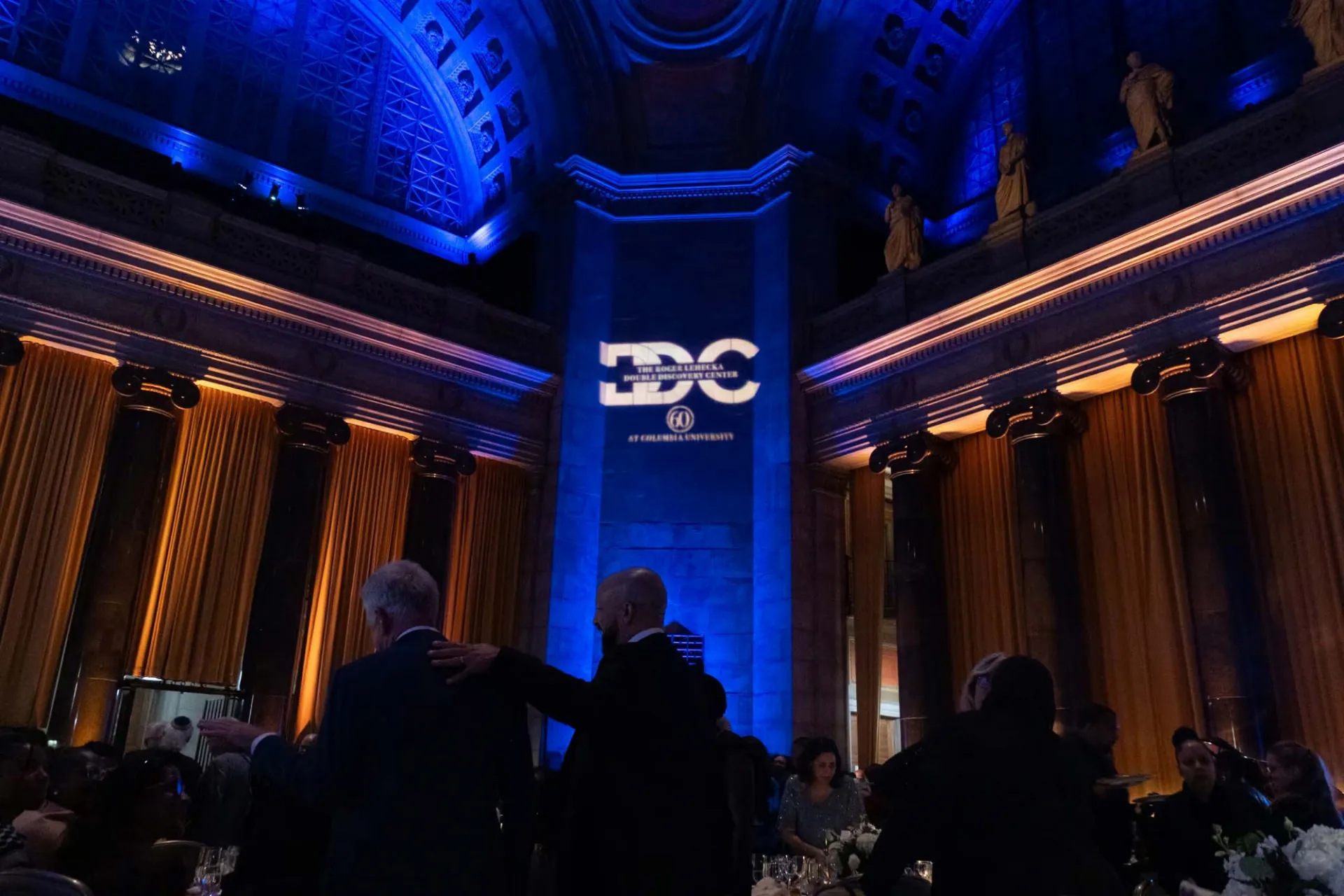
Dozens gathered in the Low Library Rotunda on Wednesday to honor the Roger Lehecka Double Discovery Center at its 60th anniversary gala.
The event featured several of the center’s founding members, including Roger Lehecka, CC ’67, GSAS ’74, lecturer of American studies and former Columbia College dean of students, as well as speeches from honorees and students of the program, and addresses from acting University President Claire Shipman, CC ’86, SIPA ’94, and Columbia College Dean Josef Sorett.
While the event celebrated the 60th anniversary of the center’s founding, it also served as a fundraiser to ensure the center’s ability to continue its mission for another six decades. After federal funding cuts in March, the DDC is searching for new ways to stay afloat.
Founded in 1965, the DDC has supported over 25,000 low-income high school students to graduate and envision themselves in higher education. The program provides free-of-charge academic courses on the weekends , summer programming at Columbia, college tours around New York City, and counseling.
On March 7, the program lost all of its federal funding from the Department of Education as a result of President Donald Trump’s administration’s $400 million grant cuts. While the July $220 million agreement with the federal government resulted in many grants being restored, the agreement explicitly excluded grants from the Department of Education.
Until March, the DDC annually served around 1,000 students in neighborhoods including Harlem, Washington Heights, and Inwood. Currently, the DDC is only able to continue its Saturday Academy programming, summer school, college tours, and emotional support for around 200 students. All of the DDC’s other federally-funded programs have been suspended, including its Talent Search grant, which served 737 students annually. Its newly-inaugurated Project Start Right grant was impacted as well.
The gala embodied the spirit of the DDC’s legacy, honoring all members of the community, and emphasized to all in attendance that the DDC is more vital than ever.
Cathleen Trigg-Jones, a member on the DDC board of friends, opened the event. Trigg-Jones began her journey with the DDC in 2019, when she was invited to serve on the board.
Growing up in foster care in northern Virginia, Trigg-Jones’ path to success is intricately tied to the DDC’s mission: Her dream was to work in television in New York City, and her first employer, who brought her to the city, was a member of the DDC’s original class of 1965.
Columbia administrators in attendance at the gala spoke to the DDC’s longstanding University wide impact. While the center is financially separate from the University, Columbia and Barnard student volunteers have been crucial to the center’s success.
“When the Double Discovery Center was founded in 1965 by two Columbia undergraduates and a Barnard student, it was a bold and hopeful experiment,” Sorett said. “It challenged the University to live out its highest ideals as its students and faculty engaged directly with the city’s young minds.”
During her address, Shipman spoke to the DDC’s connection with the broader city and praised the gala’s three honorees.
“For this University, DDC has been so instrumental in bringing groups of exceptional young minds to our campuses,” Shipman said.
The gala also included speeches from the three honorees of the James P. Shenton Award for Excellence, named after the late James P. Shenton, CC ’49, GSAS ’50, GSAS ’54, who helped establish the DDC with Lehecka. The honor is given to individuals for their “outstanding accomplishments and contributions to improving the education of college-bound, first-generation students.” Current DDC students presented awards to each honoree.
Denise De Las Nueces, CC ’03, was the first honoree to speak. De Las Nueces graduated from the DDC’s Talent Search program in 1999 and later attended Columbia College, where she volunteered at the DDC’s Summer Academy program as a student. De Las Nueces now provides medical care to Boston’s most vulnerable populations as chief medical officer of Boston Health Care for the Homeless, where she applies what she learned at the DDC with patients, who she views as “individuals who are brimming with potential, but who never had the opportunities or resources to live their full potential and also had lots of challenges in their lives.”
In an interview with Spectator, De Las Nueces explained that the DDC helped her aspire to goals she never allowed herself to “dream of before.” De Las Nueces also told Spectator about her initial reactions to the March 7 federal funding cuts, and explained that if the DDC were to close, it would “leave a massive, massive void.”
“I don’t even want to think about that scenario,” De Las Nueces explained.
Duchesne Drew, CC ’89, the second honoree to speak, serves on the University’s board of trustees. As a student at Columbia, Drew worked at the DDC as a work-study volunteer and then eventually joined the staff full-time as the development officer upon graduation. Drew spoke about how Shenton, his faculty advisor from undergraduate to graduate school, inspired him to attend graduate school.
While attending graduate school in the history department, the center paid Drew to write its annual report because of his previous position as Spectator’s 112th news editor. According to Drew, “little by little,” this work became a job that allowed him to make a living. Kevin Matthews, executive director of the DDC in 1990, then asked Drew to take a leave from his graduate program to be the chief fundraiser of the DDC.
“I spent a lot of time writing grant proposals for the Department of Education, various foundations, individuals, supporters, and got more people to know what these kinds of investments can translate into,” Drew said. “So I started to become an education reporter.”
Drew said he remains grateful that there are people who donate to support the DDC.
“I think a lot of us take pride, whether we were directly impacted by DDC or not, in what DDC has accomplished, what it means, why it matters,” Drew said. “So I’m hopeful that despite the cuts, we’ll continue to find ways to make these investments.”
Khadijah Sharif-Drinkard, CC ’93, was the third honoree at the gala. Sharif-Drinkard, who grew up nine blocks away from Columbia in the Manhattanville Housing Projects, graduated from the DDC in 1993 with her siblings and was part of both the Talent Search and Upward Bound programs.
Sharif-Drinkard had a successful career at the DDC, serving as class speaker and top scholarship winner. Today, she serves as senior vice president of business affairs at ABC News. She expressed how the DDC helped students who wanted to change the trajectory of their lives.
“I loved the program because it catered to the needs of children from a lot of diverse backgrounds who had a cross-section of challenges in life,” Sharif-Drinkard told Spectator. “The program really spoke to those of us who are yearning for something better and who are fighting for a better life for our families.”
Sharif-Drinkard called the DDC a “lifeline” for parents because it provides opportunities for them to better support their children.
“You’re donating to invest,” Sharif-Drinkard said. “You’re accepting the investment that you want to make for young people into their brilliant minds, into the courageous hearts of the young people who really are trying to do something with themselves and trying to be purposeful in their mission in life.”
In addition to its speeches, the gala featured a special performance from Tom Kitt, CC ’96, a Pulitzer Prize, Grammy, Tony, and Emmy Award-winning composer and producer. The performances also featured Broadway actors Solea Pfeiffer and Mykhel Duckett, BC ’27.
In an interview with Spectator, Kitt explained that his songs are about “young people finding their way in the world,” a subject that resonated with the gala.
In his closing remarks, Lehecka emphasized the DDC’s lasting importance both at Columbia and in the legacy of access to higher education. While his name is attributed to the center, Lehecka was adamant that he had received “more credit” than he deserves, listing individuals who contributed to the DDC’s success and lasting legacy. In 2015, an anonymous donor provided the DDC with a “significant amount of money” in exchange for Lehecka’s name being added to the center.
In particular, Lehecka credited the center’s executive directors over the years and Shenton’s key role in spearheading the organization.
“Professor Shenton denied that there had to be a wall between scholarly work and striving for justice as a citizen,” Lehecka said.
In his speech, Lehecka criticized policymakers who blame young people for lacking the “grit” to overcome obstacles in accessing higher education. He highlighted what he sees as the hypocrisy among policymakers who “do everything that they can to remove obstacles in the way of their own children,” but do not provide the same opportunities for the nation’s young people.
To Lehecka, the DDC’s mission is more important than ever in its efforts to fill this gap for local first-generation and low-income high schoolers. However, he acknowledged that inaccessibility to higher education spans far beyond the DDC’s scope, relating to structural inequalities across the United States.
“While we help Double Discovery students, while we try to have Double Discovery reach more students, let’s also try to change the way our society thinks about educational equity and social justice,” Lehecka said.